
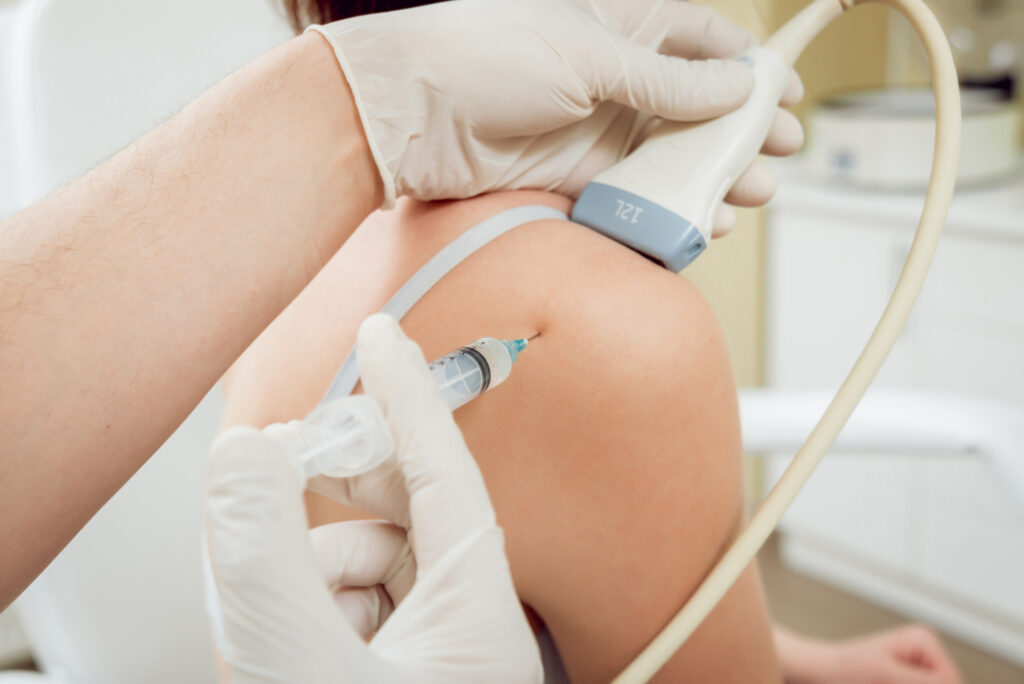
Ultrasound-guided injections use real-time imaging to help physicians precisely identify and treat joints, tendons, bursae, nerves, and other musculoskeletal structures. By visualizing the treatment area as the procedure is performed, the physician can guide the needle directly to the intended location while also seeing nearby soft tissues, nerves, and blood vessels.
Unlike imaging methods that use X-rays, ultrasound relies on sound waves and does not expose patients to radiation. It is particularly useful for procedures involving soft tissues that may not be easily visualized using other imaging techniques.


Why Is Ultrasound Guidance Used?
Precise needle placement is important when treating musculoskeletal conditions. Ultrasound allows the physician to examine the area before the procedure, identify the targeted structure and surrounding anatomy, and monitor the needle in real time as it reaches the treatment site.
This added visualization can improve the accuracy of an injection compared with relying on anatomical landmarks alone. It can also help the physician avoid nearby nerves, blood vessels, and other structures while confirming that treatment is delivered to the intended area.
What Can Be Treated?
Ultrasound guidance can be used for procedures involving many areas of the body, including the shoulder, elbow, wrist and hand, hip, knee, and other joints and surrounding soft tissues.
Depending on the diagnosis, ultrasound-guided procedures may be used to treat or evaluate conditions involving joints affected by arthritis, bursae, tendons and tendon sheaths, peripheral nerves, and other painful musculoskeletal structures. Ultrasound can also assist with certain aspirations when fluid needs to be removed from a joint, bursa, or cyst.

What to Expect
Before the procedure, the physician uses ultrasound to examine the treatment area and determine an appropriate approach. The skin is prepared, and the physician guides the needle toward the targeted structure while monitoring its position on the ultrasound screen.
Once the needle is appropriately positioned, the prescribed medication is delivered to the treatment area. The specific medication and technique used will depend on the condition being treated and the purpose of the procedure.
A More Complete Approach to Recovery
At Fortera Health, ultrasound-guided injections may be used as one component of a broader treatment plan. Depending on the patient’s needs, procedural treatment can be coordinated with physical therapy, rehabilitation, therapeutic exercise, and other non-operative care.
By combining accurate diagnosis, targeted treatment, and rehabilitation when appropriate, our team focuses on helping patients reduce symptoms, improve function, and return to the activities that are important to them.